Solana
Staking 2025
Report
A data-driven analysis of Solana’s staking transformation

415 million SOL staked, pushing supply participation to 75%.
2025 marked a turning point for Solana staking. The growth trajectory accelerated in Q3 2025 with an estimated $530 million in institutional inflows, pushing weekly transactions to around 600 million during peak periods. Unlike previous cycles dominated by liquid staking, 2025 saw native staking gain significant ground, with protocols like Marinade’s native staking TVL surging 21% quarter-over-quarter to 5.3 million SOL, surpassing even their liquid staking product mSOL for the first time.
Improved network stability (99.99% uptime vs 99.5% in 2024)
Enhanced validator economics through SIMD-96 (100% priority fees to validators)
Institutional demand for yield and infrastructure exposure
Innovation in unstaking liquidity removing traditional lockup concerns
Capital Efficiency vs Risk
Native vs Liquid Staking
Solana’s staking landscape in 2025 was defined by a clear split between native staking and liquid staking, each serving different user needs. Liquid staking tokens (LSTs) remained the default choice for DeFi users seeking composability and rehypothecation, while native staking increasingly became the preferred route for institutions and risk-aware long-term holders.
The key shift in 2025 was not that liquid staking disappeared—it didn’t—but that native staking closed the usability gap. With instant exit solutions and improved interfaces, delegating directly from self-custody wallets no longer meant sacrificing flexibility. For many participants, especially those with regulatory or custody constraints, native staking became the “clean” way to access SOL yield without added smart contract layers.
The key shift in 2025 was not that liquid staking disappeared—it didn’t—but that native staking closed the usability gap. With instant exit solutions and improved interfaces, delegating directly from self-custody wallets no longer meant sacrificing flexibility. For many participants, especially those with regulatory or custody constraints, native staking became the “clean” way to access SOL yield without added smart contract layers.
Risk Profile
Native: protocol-level risk only (consensus + validator)
Liquid: protocol + smart contract + liquidity risk
Liquid: protocol + smart contract + liquidity risk
Capital Efficiency
Native: yield only
Liquid: yield + DeFi collateral + rehypothecation
Liquid: yield + DeFi collateral + rehypothecation
User Segments
Native: institutions, long-term holders, conservative stakers
Liquid: DeFi users, traders, on-chain leverage participants
Liquid: DeFi users, traders, on-chain leverage participants
Trend in 2025
Native: staking share rising vs prior years
Liquid: staking stabilizing as a specialized, not default, option
Liquid: staking stabilizing as a specialized, not default, option
Staker Behavior
Who Actually Stakes SOL?
Behind the headline staking ratio lies a diverse mix of participants: small “shrimp” wallets staking a few SOL, mid-sized retail and crypto-native funds, and large institutional or custodial staking pools. In 2025, the number of unique staking wallets continued to grow, but the distribution of stake remained top-heavy, with a relatively small number of large entities controlling a significant share of total staked SOL.
Behaviorally, 2025 saw a shift from “set and forget” staking to more active delegation strategies. Some delegators rotated stake in response to performance, MEV policies, or downtime events, while others stuck to curated staking products that abstract validator selection entirely.
Behaviorally, 2025 saw a shift from “set and forget” staking to more active delegation strategies. Some delegators rotated stake in response to performance, MEV policies, or downtime events, while others stuck to curated staking products that abstract validator selection entirely.
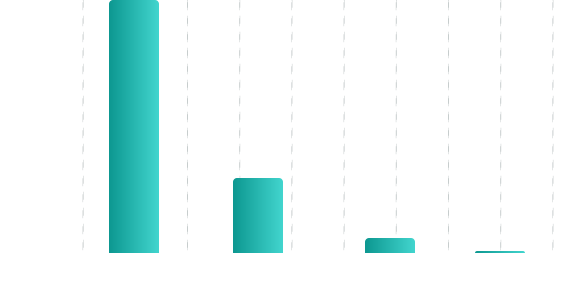
Distribution of staked SOL
Small holders (0–5 SOL): 430,102 wallets
Retail (5–500 SOL): 108,860 wallets
Crypto native funds and prosumers (500–50000 SOL): 11546 wallets
Institutions and whales (50000+ SOL): 654 wallets
Retail (5–500 SOL): 108,860 wallets
Crypto native funds and prosumers (500–50000 SOL): 11546 wallets
Institutions and whales (50000+ SOL): 654 wallets
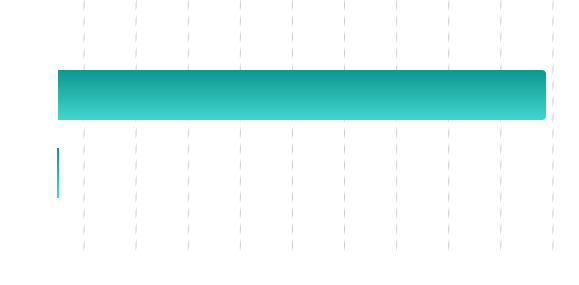
Stake per wallet
Median stake per wallet: 1.11 SOL
Mean stake per wallet: 395.18 SOL
The large gap shows that most wallets are small, revealing a high concentration of stake among big holders despite broad participation.
Mean stake per wallet: 395.18 SOL
The large gap shows that most wallets are small, revealing a high concentration of stake among big holders despite broad participation.
Growth in number of unique staking wallets YOY
Beginning of the year (Epoch 720): 552 637 wallets
Current (Epoch 884): 660,350 wallet
Current (Epoch 884): 660,350 wallet
+20%
Get your own staking report
Get a clear overview of your Marinade native staking rewards in a detailed data.
What Makes Up Staking Yield:
Breaking Down APY
Inflation emissions
Baseline rewards paid to stakers for securing the network.
Baseline rewards paid to stakers for securing the network.
Priority fees (Block rewards)
Baseline rewards paid to stakers for securing the network.Fee markets on Solana, boosted by SIMD-96
Baseline rewards paid to stakers for securing the network.Fee markets on Solana, boosted by SIMD-96
MEV Tips (Beneficial MEV):
MEV routes that share value with validators and, indirectly, delegators.
MEV routes that share value with validators and, indirectly, delegators.
Incentive Programs & Campaigns:
Temporary stake incentives or campaigns from protocols and foundations.
Temporary stake incentives or campaigns from protocols and foundations.
For most of Solana’s history, staking yield could be summarized as “inflation + a little bit of fees.” In 2025, that picture became more nuanced. With SIMD-96 directing 100% of priority fees to validators and network usage had large spikes, where a meaningful portion of validator and delegator returns came from fee revenue rather than pure emissions.
This matters because fee-derived yield is usage-driven and potentially more sustainable than inflation, which is expected to decline over time. As Solana matured, staking returns started to look less like a fixed inflationary subsidy and more like a share of the network’s economic activity.
This matters because fee-derived yield is usage-driven and potentially more sustainable than inflation, which is expected to decline over time. As Solana matured, staking returns started to look less like a fixed inflationary subsidy and more like a share of the network’s economic activity.
The $400M MEV Battle
How Solana Fought Back Against Sandwich Attacks
Sandwich attacks extracted between $370-500 million from Solana users over 16 months, with research from Sandwich.me revealing that 0.72% of all blocks contained sandwich attacks. Some validators saw exploitation in up to 27% of their produced blocks.
The ecosystem's coordinated response in 2025 reduced sandwich attack profitability by approximately 60-70%. Jito Foundation shutdown their public mempool in March, removing the easiest attack vector. Solana Foundation removed malicious validators from delegation programs, while staking protocols took direct action. Marinade Finance blacklisted 50+ validators participating in sandwich attacks across their Stake Auction Marketplace, protecting over $2 billion in delegated stake.
The ecosystem's coordinated response in 2025 reduced sandwich attack profitability by approximately 60-70%. Jito Foundation shutdown their public mempool in March, removing the easiest attack vector. Solana Foundation removed malicious validators from delegation programs, while staking protocols took direct action. Marinade Finance blacklisted 50+ validators participating in sandwich attacks across their Stake Auction Marketplace, protecting over $2 billion in delegated stake.
Sandwich bot earnings

declined 60%
Decline in front-running and slippage complaints from users and integrators
Beneficial MEV tips to validators

increased to 50-60%
Decline in front-running and slippage complaints from users and integrators
The battle is not over—attackers continue to adapt—but 2025 showed that coordinated social and economic pressure can materially reduce exploitative MEV without eliminating healthy arbitrage.
Decentralization Metrics for staking
01
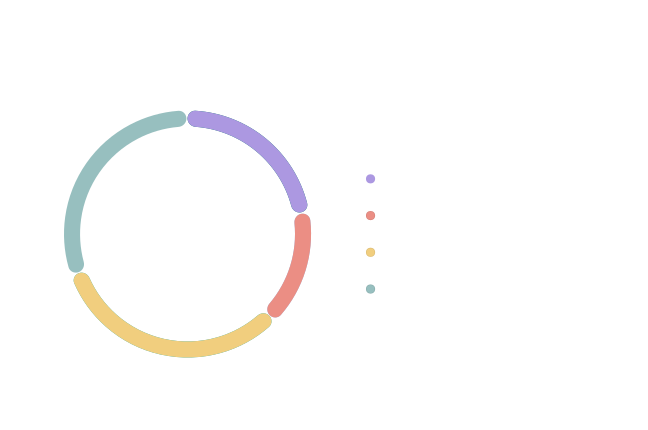
As Solana grew into a systemically important piece of crypto infrastructure, questions about who controls the network became more urgent. In 2025, decentralization could no longer be evaluated only by counting validators; it required a deeper look at stake distribution, vote weight concentration, and operator diversity.

02
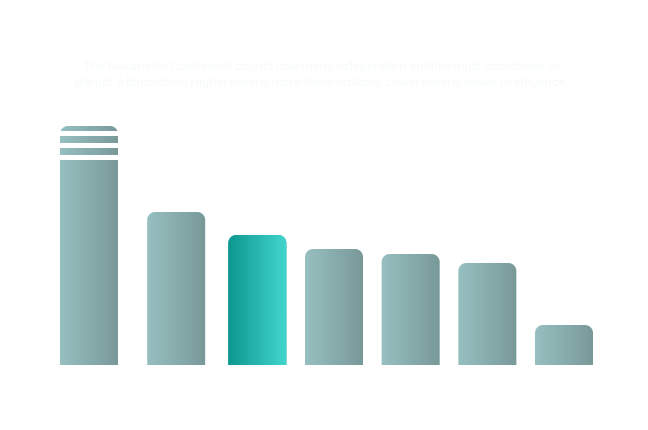
While the total number of validators remained healthy, stake was still skewed toward the top of the distribution. A relatively small number of validators and staking intermediaries controlled a large share of voting power. At the same time, client diversity began to improve as alternative implementations like Firedancer entered testing, reducing the risk of a single-client bug taking down the network.

03
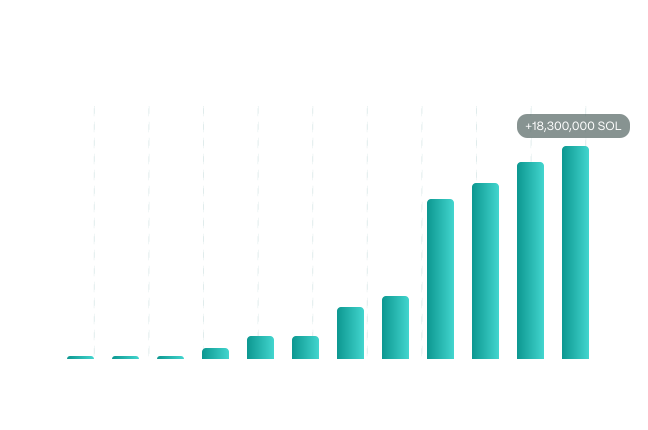
Corporate holdings of SOL reached 18.3 million SOL in December. Publicly listed firms such as Forward Industries, Sharps Technology, Upexi, and DeFi Dev Corp accounted for a growing share of the total. Their accumulation highlighted a shift in how institutional actors interacted with the network and added a new dimension to discussions about influence and governance.

04
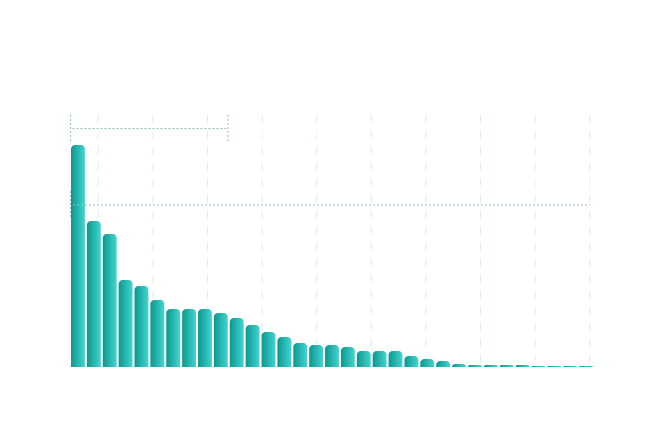
Stake on Solana is mostly concentrated among the largest withdraw authorities. The top 10 % holds a significant share, with the leading group alone controlling 22.43% of stake. As the curve continues, the top 100 authorities already surpass the halfway point, holding more than half of all staked SOL. This distribution shows where effective influence accumulates and underscores the value of broader delegation to support decentralization with Marinade.
Asia
9%
45
85
USA
17%
39
-99
Europe
73%
50
8
Why There Are 150+
Validators Concentrated in Frankfurt
By late 2025, Europe held more than 73% of all Solana validator locations, and Frankfurt sat at the center of that cluster. More than 150 validators operated from a single data center region in the city, leading to 30% geographic concentration in a relatively narrow footprint. The core driver was simple: latency is money.
Frankfurt became the preferred location because its position on major European network routes offered naturally lower latency and more consistent block propagation than most other regions. Operators found that even standard setups in Frankfurt outperformed equivalent hardware elsewhere.
Specialized networks such as those offered by DoubleZero provided additional optimization paths, but they were not the reason the ecosystem concentrated there. The clustering was already forming around Frankfurt’s baseline performance advantage.
The trade-off was clear. While validators benefited from stronger performance and more predictable rewards, concentrating so many nodes in one region increased geopolitical and infrastructural risk.
Worldwide stake distribution (Source: syndica.io)
Frankfurt became the preferred location because its position on major European network routes offered naturally lower latency and more consistent block propagation than most other regions. Operators found that even standard setups in Frankfurt outperformed equivalent hardware elsewhere.
Specialized networks such as those offered by DoubleZero provided additional optimization paths, but they were not the reason the ecosystem concentrated there. The clustering was already forming around Frankfurt’s baseline performance advantage.
The trade-off was clear. While validators benefited from stronger performance and more predictable rewards, concentrating so many nodes in one region increased geopolitical and infrastructural risk.
Worldwide stake distribution (Source: syndica.io)
Unstake Activity in 2025
Liquidity, Volatility, and Instant Unstake
Unstaking behavior in 2025 provided a real-time window into market sentiment. Spikes in unstake requests often coincided with sharp price moves, liquidity crunches, or macro events, as participants rushed to regain flexibility. Historically, the 2-day unstake delay for native SOL created a painful trade-off: earn yield, but risk being “trapped” during volatility.
This changed materially with the emergence of instant unstake solutions. In Q2 2025, Marinade’s Instant Unstake product launched, allowing users to exit their staking positions immediately in exchange for a modest fee, backed by a liquidity pool managed by the protocol.
By Q4, cumulative instant unstake volume had reached approximately 200,000 SOL, with individual transactions in the tens of thousands. As 1500 users discovered the feature, unstaking patterns shifted: rather than pre-emptively avoiding staking due to lockups, users staked confidently, knowing they had a fast exit if needed.
This changed materially with the emergence of instant unstake solutions. In Q2 2025, Marinade’s Instant Unstake product launched, allowing users to exit their staking positions immediately in exchange for a modest fee, backed by a liquidity pool managed by the protocol.
By Q4, cumulative instant unstake volume had reached approximately 200,000 SOL, with individual transactions in the tens of thousands. As 1500 users discovered the feature, unstaking patterns shifted: rather than pre-emptively avoiding staking due to lockups, users staked confidently, knowing they had a fast exit if needed.
Key Effects:
- Overall unstake volume increased as friction decreased
- Native staking became more attractive relative to liquid staking for users who previously chose LSTs only for exit liquidity
- Institutions gained a practical way to combine full custody + instant liquidity, aligning staking with treasury and risk frameworks
- Short-term speculative unstaking during volatility was increasingly routed through instant liquidity pools instead of waiting out the full epoch delay
The innovation bridges the gap between native staking's security benefits (no smart contract risk, full custody) and liquid staking's capital efficiency.
2 days wait Instant
By Q4, cumulative instant unstake volume had reached approximately 200,000 SOL
200,000 SOL instantly unstake via Marinade

Alpenglow
How Solana Will Achieve 80x Faster Finality
In September 2025, SIMD-0326 (“Alpenglow”) passed with overwhelming validator support, setting Solana on a path to sub-150ms finality in 2026. The upgrade introduces a redesigned consensus flow — including mechanisms like Votor-style voting and more efficient propagation — aimed at drastically reducing the time between transaction submission and cryptographic finalization.
Today’s DeFi and trading applications on Solana already operate on probabilistic finality assumptions, accepting a small risk window in exchange for speed. Alpenglow’s promise of near-instant finality changes that equation, enabling true L1 settlement workflows that rival Web2 user experiences while retaining cryptographic guarantees.
Today’s DeFi and trading applications on Solana already operate on probabilistic finality assumptions, accepting a small risk window in exchange for speed. Alpenglow’s promise of near-instant finality changes that equation, enabling true L1 settlement workflows that rival Web2 user experiences while retaining cryptographic guarantees.
Firedancer
The Client That Hit 1 Million TPS
Firedancer, the independent validator client developed by Jump Crypto, moved from concept to reality in 2025. In controlled tests, it reached over 1 million transactions per second, and it demonstrated sustained 100,000+ TPS on mainnet-adjacent environments — numbers well beyond Solana’s current production load.
By late 2025, roughly 15% of validators were actively testing or preparing to adopt Firedancer in parallel with the existing Agave client. This emerging client diversity reduces systemic risk: a bug or exploit in one implementation is less likely to cause a network-wide outage when multiple independent clients can keep the chain moving.
By late 2025, roughly 15% of validators were actively testing or preparing to adopt Firedancer in parallel with the existing Agave client. This emerging client diversity reduces systemic risk: a bug or exploit in one implementation is less likely to cause a network-wide outage when multiple independent clients can keep the chain moving.
Throughput improvement potential. Significantly reduced compute requirements
10x
Validators lower operational costs

15-20%
Looking ahead
The groundwork laid in 2025 sets the stage for a structurally different Solana staking ecosystem in 2026. With Alpenglow on track for phased rollout, Firedancer moving toward production readiness, instant liquidity solutions maturing, and more institutional stake entering the system, staking is evolving from a yield primitive into a core part of global financial infrastructure.
Higher share of yield
Higher share of yield coming from real network usage (fees, MEV tips) vs pure inflation
Growth of staking
Potential growth of staking TVL toward $20–50B+ under various market scenarios
Adoption increase
Broader adoption of instant liquidity primitives, making native staking the default instead of the “illiquid” option
Decentralization
Improved decentralization metrics if stake distribution, geography, and client diversity continue to progress
Be first to receive the upcoming Solana staking report
Enter your email to receive the report and join the beta for a personalized staking report based on your wallet.